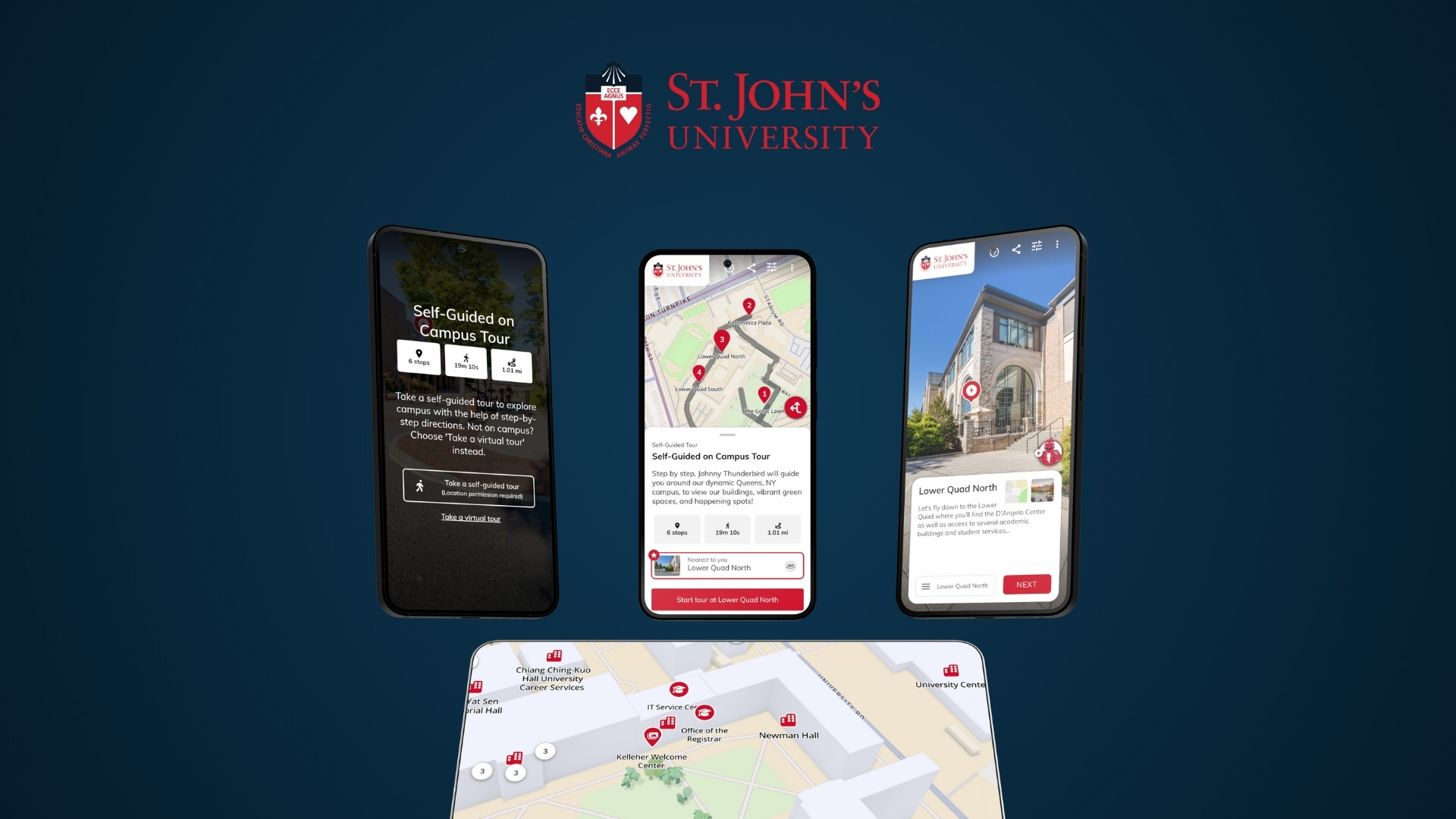
With the launch of the first phase of their virtual tour in advance of the Fall 2024 recruitment cycle, St. John’s University prioritized using Circuit’s Map and Self-guided tour features to support wayfinding on campus and campus visitors’ individual exploration. By requiring a form submission to access their self-guided tour and promoting their map through a QR code, St. John’s was able to turn stealth visitors into leads.
The problem St. John’s set out to solve
St. John's University faced a key challenge: how to create a seamless, high-quality campus experience for all visitors, regardless of when they arrived or how they preferred to explore the campus. With a limited number of student ambassadors during summer months and between peak visitation periods, St. John’s sought a digital tool that could complement the high quality visit experience of their campus tour program, while capturing valuable visitor engagement data and insights in Slate.
Prior to partnering with Circuit, our “Self Guided Campus Tour” consisted of a series of videos and a basic campus map, originally developed as a temporary solution during the COVID years. While it fulfilled its purpose at the time, we quickly recognized the need for an upgrade that could match the trackability and high quality of our on-campus visit experiences. During our search for alternatives we discovered that Circuit not only met these needs, but exceeded our expectations in every way.
-Francine Maione, Campus Visit Coordinator
With this tool, St. John’s aimed to serve three audiences: remote prospects researching the university, on-campus visitors who need wayfinding assistance, and visitors who are looking for a way to independently tour campus. After careful evaluation, the St. John’s team settled on Circuit, with plans to leverage the Map and Self-guided Tour features to transform their campus visit experience.
The solution: launching St. John's campus map on Circuit
With Circuit’s Map feature, the St. John's team saw an opportunity to support both prospective and current students with navigation around campus. Student-facing offices field many questions about wayfinding, whether during the first weeks of classes, or during on-campus events. St. John's collaborated with the Circuit team to digitize their graphic campus map on the Circuit platform.
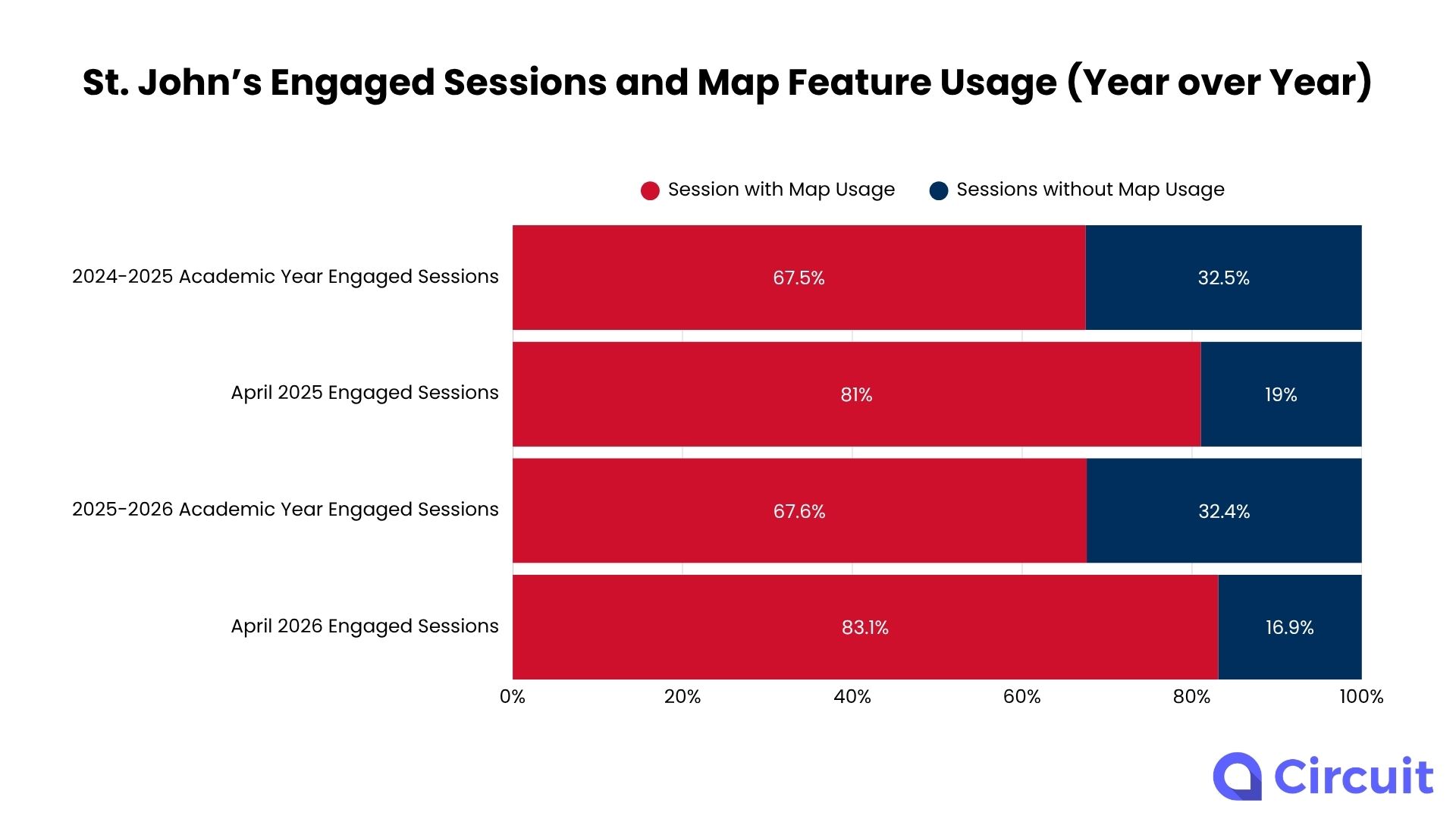
As soon as their Queen's Campus Map was ready, the St. John’s University’s Kelleher Welcome Center prominently shared it using a QR code with designated UTM tracking. During the 2024-2025 academic year, 67.45% of their total engaged sessions on Circuit included use of their Map feature, with 5% of overall Circuit platform traffic specifically coming from the tracked Map QR code. The Map QR code was most prominently used during the months of September to November, during the peak recruitment season, as well as when helping first-year students navigate campus.
.jpg)
Building on this foundation, the 2025-2026 academic year saw explosive platform growth. Total virtual tour visitors skyrocketed by 52% year-over-year, and total engaged sessions saw a 34% increase compared to the previous year, with 31% more sessions with map usage. The map has continued to serve as a vital tool during the peak recruitment season from September to November, as well as when helping first-year students and visitors navigate the campus.
This strategic map integration proves especially powerful during large-scale campus events. In April 2025, St. John’s used their digital map to support wayfinding during their Accepted Student Day, resulting in 81.04% of their Circuit-engaged sessions utilizing the Map feature that month. When replicating this strategy in April 2026, the results were even more impressive thanks to a heightened, multi-channel promotional approach:
- Email Integration: All confirmation emails (registration, one-week reminder, and 24-hour reminder) included a direct link to the map.
- SMS & Check-in Reminder: During check-in, visitors received a text message containing the map link, and staff verbally reminded guests to use the map to navigate between sessions.
- Printed Signage: Printed 24x36 QR code signs were placed in high-traffic areas across campus. Printed 8.5x11 QR codes were displayed prominently at all check-in tables.
.jpg)
These increased efforts yielded incredible results. April 2026 saw a 59% increase in total visitors and a 54% increase in engaged sessions compared to April 2025. Even with this much larger audience, proportional map usage climbed to an incredible 83.10% of all engaged sessions—representing a massive 57% increase in total map sessions year-over-year.
As a parent who’s visited universities, I understand how essential a seamless arrival experience is to the overall campus visit. As the “Welcome Center” on campus, we also observed that first-year students had a significant need for effective wayfinding. Our mission became creating a smooth and intuitive experience that addressed both of these needs. By incorporating QR codes at our center and in event programs, along with live URL links in our visit communications, we were able to maximize the utility of our maps and better serve both prospective families and incoming students. Additionally, providing access to specialized spaces, such as labs and studios that aren’t included in our daily tours, proved to be a valuable enhancement, offering visitors a more comprehensive view of campus life and academic opportunities.
-Francine Maione, Campus Visit Coordinator
Year-over-year, proportional map usage remained remarkably steady, even growing slightly, with 67.6% of all engaged sessions using the map throughout the 2025-2026 academic year.
By providing easy access via simple QR codes and digital links, campus visitors seamlessly self-navigated to designated parking and event locations, proving the map's scalable value year after year. St. John's proves that when you position the map as an easy-access tool across multiple touchpoints, simultaneous annual growth in both overall visitor volume and feature engagement is absolutely possible.
The solution: launching St. John's self-guided tour on Circuit
With Circuit’s Self-guided feature, the St. John's team was looking for a tool to offer a high-quality experience to campus visitors during non-peak seasons. For example, occasionally visitors from outside the region might come to campus during Catholic holidays or during a holiday break and their experience was limited.
Once their campus map was built out in Circuit, St. John’s University was able to integrate it with their Circuit virtual tour content to power a self-guided tour. St. John’s self-guided tour leads visitors in a loop around campus to key student life spaces, including The Great Lawn, Carnesecca Arena, the D’Angelo Center, and their Residence Village. Using this Circuit feature, St. John’s provides a top-notch experience with key information in an incredible way.
As a hidden tour, the self-guided tour was only accessible to campus visitors through a QR code at the Kelleher Welcome Center and did not display on their virtual tour homepage. This allowed the St.John's team to gate their self-guided tour using a Slate CRM form, and capture valuable insights about the cohort who accessed this tour.
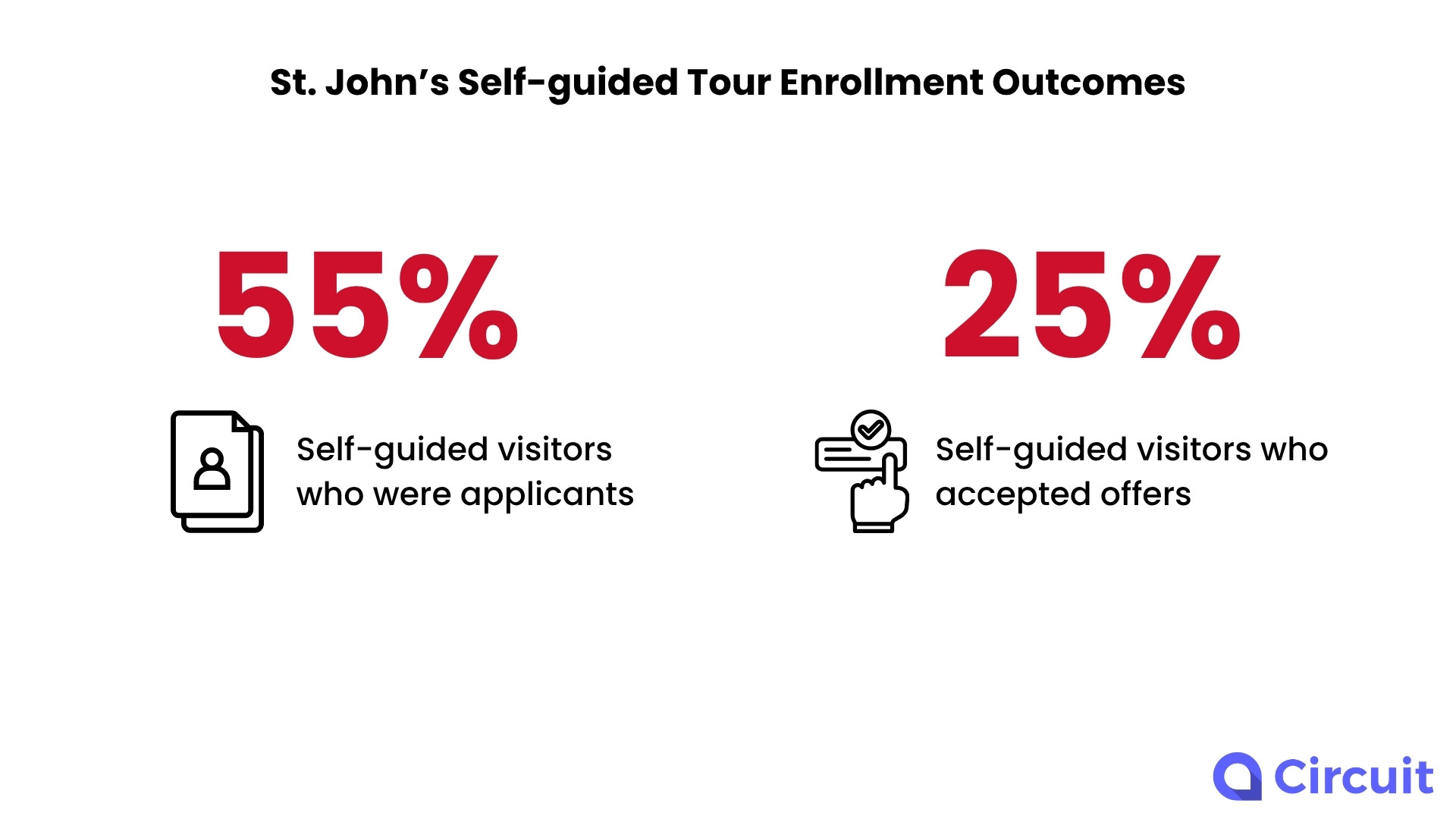
From January-June 2025, St. John’s analyzed that 55% of their self-guided visitors were applicants to St. John’s, with the majority visiting from the surrounding mid-Atlantic region. Of those who received an offer of admission, 25% enrolled.
A visit for all Johnnies
As they enter their second academic year with Circuit, St. John’s continues to expand their virtual tour content, promotion of their Map and Self-guided tour features, and analytics tracking using Slate Ping integration.
St. John’s use of Circuit Virtual Tours, Map, and Self-guided Tours is truly unifying the visit experience whether their visitor is at home or on-campus, and no matter their stage of student enrollment. With Circuit, St. John’s provides a top-tier digital experience for all Johnnies! Explore St. John’s University on Circuit.