Why student stories matter
Prospective students don’t choose a university because they’ve seen every classroom. They choose a university when they can picture themselves there.
Storytelling is about making a lasting impression. Student storytelling is powerful because it shifts the centre of gravity from the institution to the student. When student voices lead the experience, the tour stops being a showcase of buildings and history and starts being an invitation to imagine what it would feel like to study, live, and belong there.
Across higher education, institutions are finding creative ways to bring those voices into their virtual tour experiences, through student spotlight tours, day-in-the-life journeys, and student videos sourced directly from social media. Here are three ways institutions are putting that into practice.
1. Create dedicated student spotlight tours
Prospective students arrive at a virtual tour with an unspoken question: is there someone like me here? A spotlight tour is the only format that answers it directly.
Rather than representing the institution broadly, it lets visitors find a student who shares their interests, background, or concerns — and follow their story. Peer voices carry a credibility that institutional copy can't replicate: a student explaining why they chose a program, what surprised them, or what they'd tell a future applicant feels honest in a way that marketing language rarely does.
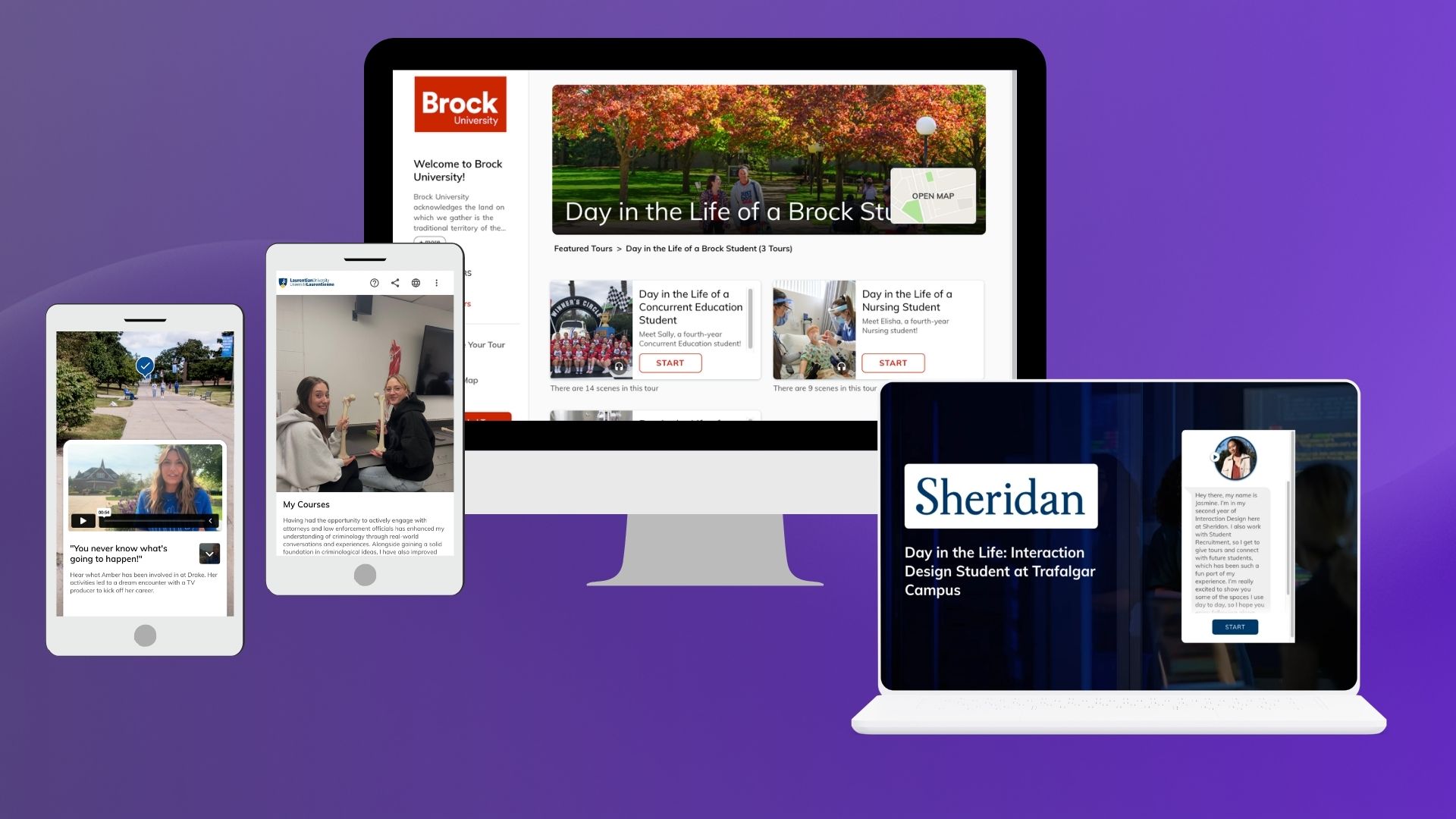
Laurentian University put this into practice by creating individual student spotlight pages, each featuring curated photos, videos, and student-written stories covering why they chose Laurentian, what they enjoy most, and advice for prospective students. The result was a 70% completion rate and an average session duration of 3 minutes and 51 seconds, outperforming comparable tours of this length by 16%.
How Laurentian did this:

2. Build a day-in-the-life tour
A traditional tour shows where things are. A day-in-the-life tour shows how a student actually moves through campus, from arriving for class to studying, meeting friends, and using support services. The difference matters because when prospective students are given a blueprint for what campus life actually looks like, they spend less time evaluating facilities and more time imagining themselves participating in it.
Sheridan College took this approach by repurposing existing 360° scenes and layering in student-written, student-narrated stories using a combination of AI voiceovers and live recordings, letting students define the narrative rather than the institution. The resulting tours had completion rates between 25–39% and a median increase in duration of more than 8 minutes.
How Sheridan did this:

3. Embed student videos throughout the tour
Visitors may spend only a few moments in any given scene. A 360° image can show prospective students what a space looks like, but a student on camera can show them how that space is actually used. Embedding student videos through social media also brings a familiar, engaging format into the tour, giving prospective students another way to research your campus.
Drake University built its tour around 1 to 2 minute videos in key spaces, with students and faculty speaking about the rooms they were standing in. Average tour duration ran 25% above benchmark. That tracks with a broader pattern in our 2025 data: 360° scenes with video held attention 54% longer than scenes without, and for gallery-style scenes the gap widened to 119%.
How Drake did this:

Conclusion
The most successful virtual tours don't just showcase campus spaces, they help prospective students picture themselves as part of the community. Whether through spotlight tours, day-in-the-life journeys, or student videos pulled from social media, the common thread is the same: the story belongs to the student, not the institution.
You likely already have what you need. Students willing to talk about why they chose you, content they've already made, and spaces worth showing. Circuit is built to make putting those pieces together straightforward, so the harder question isn't how to build it. It's whose voice you want students to hear first.